
Picture a cholesterol report that comes back looking perfect. LDL 118 mg/dL. HDL 60. Triglycerides 100. Total cholesterol is 198, just under the famous 200 line. Every result in the green, and the person holding it closes the lab portal and gets on with his day. The gap between a number and what it means is where most cholesterol confusion comes. It is why the story we all learned, LDL bad and HDL good, leaves some people falsely reassured and others needlessly scared.
The stakes are real. The CDC reports that about 86 million US adults have a total cholesterol of 200 mg/dL or higher and that only slightly more than half of the adults who could benefit from cholesterol medicine are taking it. High cholesterol rarely gives any warning, so plenty of people find out late.
In March 2026, the American College of Cardiology (ACC) and the American Heart Association (AHA), joined by nine other medical organizations, published a new guideline. It brings back numeric LDL goals, asks every adult to get one inherited marker called lipoprotein, or Lp, tested at least once, and builds its advice around a simple idea the longer your arteries are exposed to too much LDL, the more damage adds up.
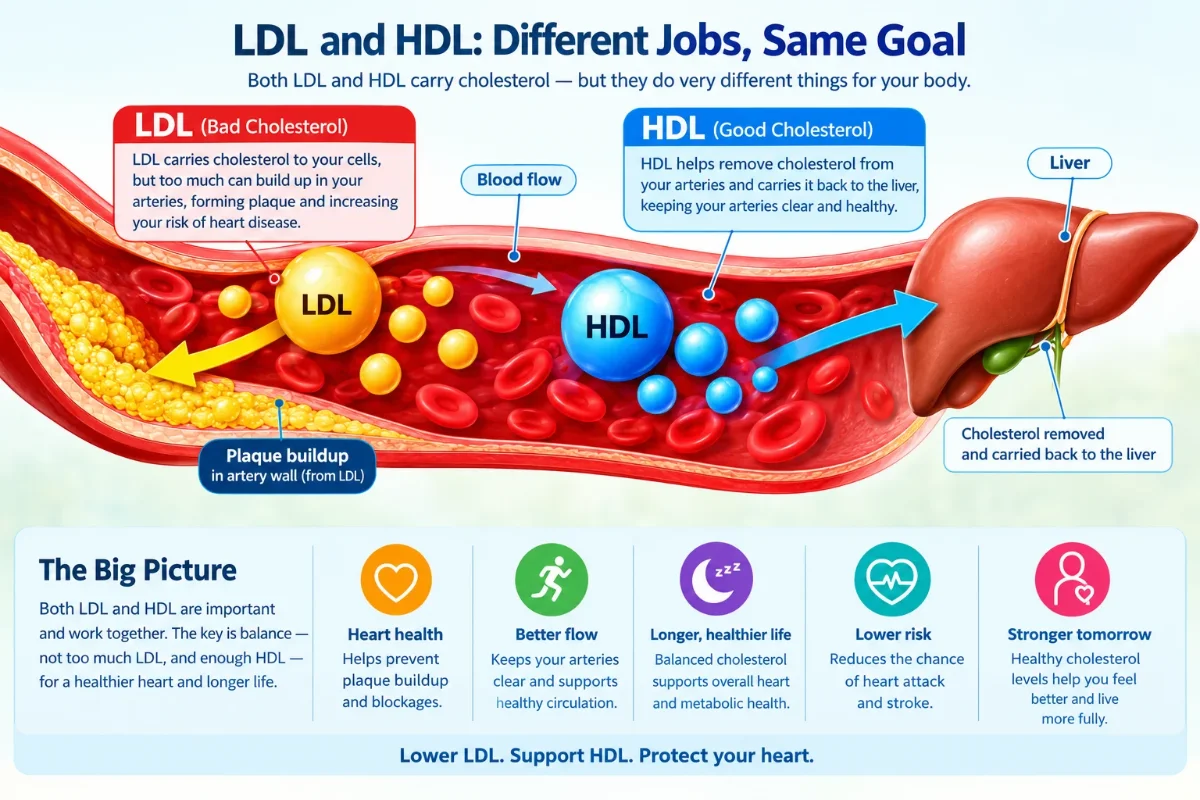
LDL cholesterol carries cholesterol to your tissues, and when it stays high for years, it helps build plaque in artery walls, raising the risk of heart attack and stroke. HDL cholesterol carries cholesterol back to the liver. Higher HDL goes with lower risk, but drugs that raise HDL have not prevented heart attacks, so LDL is the number doctors aim to lower.
The key points at a glance
| Key Point | Details |
|---|---|
| Cholesterol is necessary | Your body needs cholesterol. The danger is too many plaque-forming particles, mainly LDL, for too many years. |
| HDL isn’t a safety net | A high HDL does not cancel a high LDL, and very high HDL is not a guarantee of safety. |
| LDL goals vary by risk | Goals now depend on your risk level: below 100, 70, or 55 mg/dL (2.6, 1.8, or 1.4 mmol/L). |
| No symptoms | High cholesterol has no symptoms. A blood test is the only way to know. |
| Get an Lp(a) test | Ask for this once in your life — it’s inherited, not on a standard panel, and it changes your risk. |
| Genes set the limits | Diet, exercise, and weight help, but genes decide how far they can take you. Needing medication is not a personal failure. |
What is the difference between HDL and LDL cholesterol?
LDL (low-density lipoprotein) carries cholesterol from the liver to your tissues. If too much of it circulates for too long, particles slip into the artery wall and get stuck, and over the years they build plaque. That plaque narrows arteries and can rupture, which is how many heart attacks and strokes begin.
HDL (high-density lipoprotein) makes the return trip. It picks up excess cholesterol and carries it back to the liver for disposal. People with naturally higher HDL tend to have less heart disease, and that is where the “good cholesterol” nickname comes from.
| LDL | HDL | |
| Full name | Low-density lipoprotein | High-density lipoprotein |
| Nickname | “Bad” cholesterol | “Good” cholesterol |
| Main job | Delivers cholesterol to tissues | Returns cholesterol to the liver |
| Why it matters | High levels feed plaque in the arteries. | Higher levels go with lower risk, but raising HDL has not been shown to protect the heart. |
| Treatment target? | Yes, lowering it is the main goal. | No |
The nicknames are fine for a first pass. They stop working when you ask a harder question.
What is cholesterol, and why does your body need it?
Cholesterol is a waxy, fat-like substance found in every cell. It is part of cell membranes, and the body uses it to make hormones such as estrogen, testosterone, and cortisol, along with vitamin D and the bile acids that digest fat. The liver makes most of the cholesterol in the body. The rest comes from food. Fat and blood don’t mix, so cholesterol travels inside carriers called lipoproteins. LDL and HDL are two of them. A standard lipid profile reports four numbers:
- Total cholesterol
- LDL cholesterol
- HDL cholesterol
- Triglycerides, a separate blood fat the body uses for energy
You will also see non-HDL cholesterol, which is simply total cholesterol minus HDL. It captures the cholesterol in LDL and in other particles that can damage arteries, such as triglyceride-rich remnants and Lp. The 2026 guideline calls this whole group atherogenic (plaque-forming) lipoproteins.
Cholesterol myths and facts
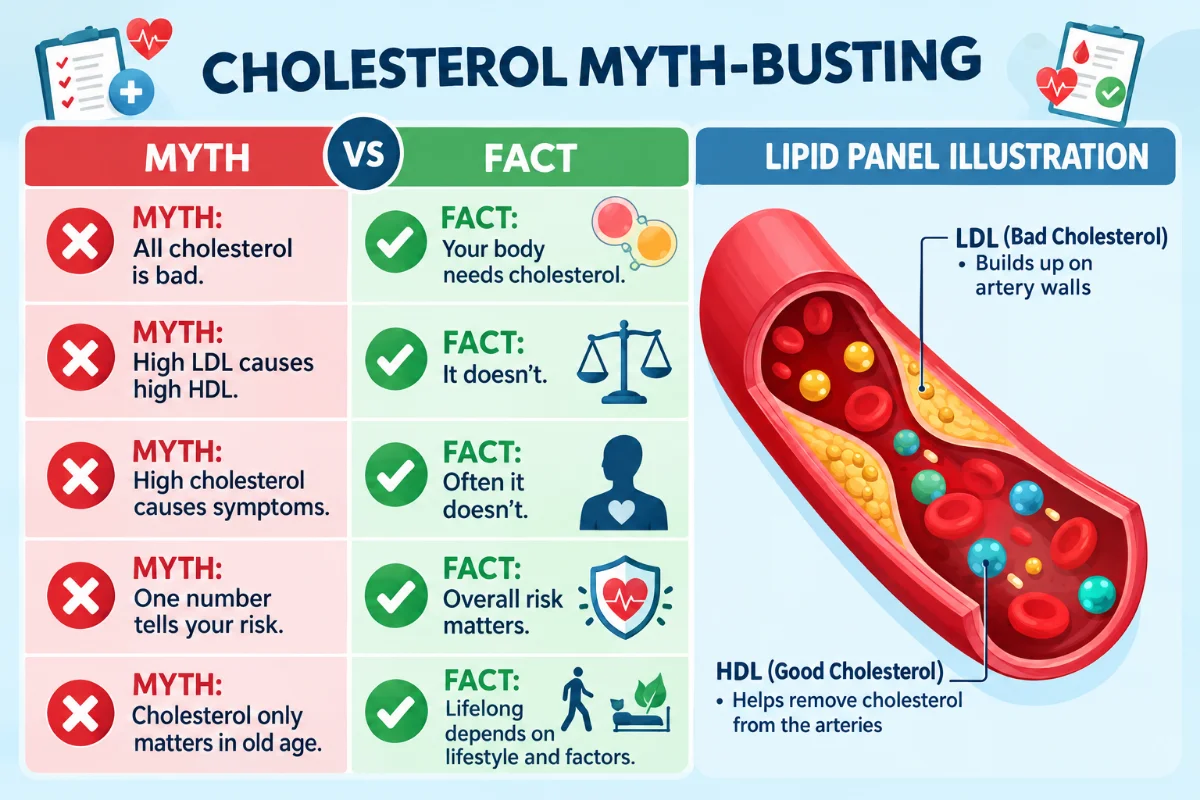
Here is the short version first. The detail follows below.
| The myth | What is actually true |
| All cholesterol is bad. | Your body needs it. The problem is excess plaque-forming particles. |
| The higher my HDL, the better. | Raising HDL with drugs hasn’t prevented heart attacks, and very high HDL isn’t clearly protective. |
| A high HDL cancels a high LDL. | It doesn’t. |
| High cholesterol causes symptoms. | It usually causes none. |
| Total cholesterol under 200 means I’m fine. | No single number shows your risk. |
| Eggs are the main cause of high cholesterol. l | Saturated fat, genes, and other factors matter more for most people. |
| Diet and exercise are always enough. | Genetics can override even excellent habits. |
| Statins are only for people who’ve had a heart attack | They are also used for prevention. |
| Cholesterol only matters when you’re older. | Plaque builds over decades. |
| If my LDL is normal, I’m covered. | Lp, non-HDL, and triglycerides add information. |
| Supplements can replace treatment. | The guideline doesn’t recommend them for lowering LDL or triglycerides. |
What do your cholesterol numbers mean?
1. Standard lab ranges
Most lab reports still use the traditional categories below. Countries report them in different units: the US uses mg/dL, while the UK and many other countries use mmol/L. To convert cholesterol values from mg/dL to mmol/L, divide by 38.7. For triglycerides, divide by 88.6.
| Measurement | mg/dL | mmol/L |
| Total cholesterol | Under 200 desirables; 200-239 borderline high; 240 and above high | Under 5.2; 5.2-6.2; 6.2 and above |
| LDL cholesterol | Under 100 optimal; 100-129 near optimal; 130-159 borderline high; 160-189 high; 190 and above very high | Under 2.6; 2.6-3.3; 3.4-4.1; 4.1-4.9; 4.9 and above |
| HDL cholesterol | Under 40 (men) or 50 (women) is low; 60 and above is higher. | Under 1.0 or 1.3 is low; 1.6 and above is higher. her |
| Triglycerides | Under 150 normal; 150-199 borderline high; 200-499 high; 500 and above very high | Under 1.7; 1.7-2.2; 2.3-5.6; 5.6 and above |
| Non-HDL cholesterol | Under 130 is the usual general reference. | Under 3.4 |
These are broad categories, not personal targets. A number in the “optimal” range can still be too high for someone with heart disease, and printed ranges vary slightly between labs.
Two figures deserve special attention. An LDL of 190 mg/dL (4.9 mmol/L) or higher is classed as severe hypercholesterolemia, and it should prompt a medical check for an inherited cause such as FH. And triglycerides of 1,000 mg/dL (11.3 mmol/L) or higher raise the risk of pancreatitis and need prompt treatment.
2. Your LDL goal depends on your risk.
There is no single LDL target for everyone. The 2026 guideline sets goals by risk category:
| Who | LDL-C goal | Non-HDL-C goal |
| Primary prevention, borderline or intermediate risk | Below 100 mg/dL (2.6 mmol/L) | Below 130 mg/dL (3.4 mmol/L) |
| Primary prevention, high risk (10-year risk of 10% or more) | Below 70 mg/dL (1.8 mmol/L) | Below 100 mg/dL (2.6 mmol/L) |
| Existing heart or vascular disease, not very high risk | Below 70 mg/dL (1.8 mmol/L) | Below 100 mg/dL (2.6 mmol/L) |
| Existing disease, very high risk | Below 55 mg/dL (1.4 mmol/L) | Below 85 mg/dL (2.2 mmol/L) |
“Very high risk” generally means more than one major cardiovascular event, or one major event plus several other high-risk conditions such as diabetes, smoking, high blood pressure, or age over 65. Your doctor decides which category applies to you.
3. Risk enhancers: what tips a borderline decision
- A parent or sibling with early heart disease (before age 55 in men or 65 in women)
- Diabetes, chronic kidney disease, or obesity
- Chronic inflammatory conditions, such as lupus or rheumatoid arthritis
- South Asian or Filipino ancestry, or another ancestry linked to higher risk
- Early menopause, preeclampsia, or gestational diabetes
- Elevated Lp or triglycerides
Why South Asian ancestry deserves extra attention
The 2026 guideline names South Asian ancestry as a risk enhancer. That means it can move a borderline decision toward treatment, and it is a good reason to check cholesterol, blood sugar, and blood pressure early, even if you are slim and feel well.
1. What causes high LDL cholesterol?
High LDL usually comes from a mix of causes:
- Genetics. FH and other inherited patterns can cause very high LDL despite a healthy lifestyle.
- Diet. Eating a lot of saturated fat and trans fat raises LDL. Butter, ghee, fatty and processed meats, and full-fat dairy are common sources of saturated fat. Trans fat can still turn up in some packaged foods and in partially hydrogenated cooking fats, so check the label.
- Body weight and inactivity. Excess weight and low activity tend to raise LDL and triglycerides and lower HDL.
- Medical conditions. An underactive thyroid, chronic kidney disease, kidney conditions that cause protein loss, and diabetes can all affect lipids.
- Medicines. Some steroids, immune-suppressing drugs, and HIV treatments can raise cholesterol or triglycerides.
- Age and family history.
High LDL is often not a matter of willpower. Someone with excellent habits can still have it.
2. How can you lower your cholesterol?
- Eat more fiber. Oats, barley, beans, lentils, apples, pears, and vegetables provide soluble fiber. Getting roughly 5 to 10 grams a day is linked to modest LDL reductions.
- Swap your fats. Replace saturated fat with unsaturated fat from olive and other liquid plant oils, nuts, seeds, and avocado. The AHA suggests keeping saturated fat to about 5% to 6% of daily calories. Avoid trans fat.
- Eat fish, but know what it does. Mayo Clinic notes that omega-3 fats from fish such as salmon and mackerel don’t lower LDL, but they can lower triglycerides.
- Move regularly. Aim for at least 150 minutes a week of moderate activity, such as brisk walking. Mayo says even 60 minutes a week of moderate aerobic exercise can raise HDL and lower triglycerides.
- Lose excess weight. Even a modest loss can improve LDL, triglycerides, and HDL.
- Quit smoking. Smoking lowers HDL and sharply raises cardiovascular risk. Stopping is one of the most effective things you can do for your heart.
- Take prescribed medicine. If you’ve been prescribed a statin or another lipid-lowering drug, take it as directed, and raise side effects with your doctor before changing anything.
A plate that supports your heart

No single food lowers cholesterol on its own. Build meals around a pattern:
| Food group | Examples |
| Whole grains | Oats, barley, brown rice, whole-wheat roti, or bread |
| Legumes | Lentils (daal), chickpeas, kidney beans |
| Vegetables | Leafy greens, broccoli, tomatoes, peppers |
| Fruit | Apples, oranges, berries, pears |
| Nuts and seeds | Walnuts, almonds, pistachios, flaxseed, chia |
| Fish | Salmon, sardines, trout, mackerel |
| Unsaturated oils | Olive, canola, sunflower, and other liquid plant oils |
Eat these less often processed meats, deep-fried foods, sugary drinks, packaged snacks and pastries, and dishes made with large amounts of butter, ghee, or other saturated fat. Nobody needs a perfect diet. The overall pattern over months and years is what counts.
How is cholesterol tested?
A lipid panel is a simple blood test. Many people don’t need to fast for it, and the guideline says non-fasting results are useful for most purposes. Fasting is sometimes preferred, for example, to diagnose high triglycerides, to check leftover risk in someone already on treatment, or to screen people with a family history of early heart disease. Follow the instructions from your lab or doctor.
How often you should be tested depends on age and risk. The CDC says most healthy adults should be checked every 4 to 6 years, and more often if they have heart disease, diabetes, or a family history of high cholesterol. The 2026 guideline suggests every five years for healthy young adults starting at age 19, with more frequent testing as you get older or if you have risk factors. Children should be checked at least once between ages 9 and 11. If you’ve been diagnosed with high cholesterol or are on treatment, your doctor will set the schedule and will repeat the test to check that your treatment is working.
When should you see a doctor?
Talk to a doctor soon if you have:
- An LDL of 190 mg/dL (4.9 mmol/L) or higher
- A parent, sibling, or child with early heart disease or known familial hypercholesterolemia
- Diabetes, kidney disease, or a chronic inflammatory condition
- Triglycerides that stay high across tests
- A previous heart attack, stroke, or known artery disease
High cholesterol doesn’t cause chest pain. But if you have chest pain or pressure, breathlessness, sudden weakness on one side, trouble speaking, or sudden vision changes, call emergency services right away.
Frequently asked questions
Q1: What is the difference between HDL and LDL cholesterol?
LDL carries cholesterol to your tissues, and high levels over many years build plaque in artery walls. HDL carries cholesterol back to the liver. Higher HDL is linked to lower risk, but raising it with drugs hasn’t reduced heart attacks, so LDL is the main treatment target.
Q2: Is high HDL always good?
No. Higher HDL usually goes with lower risk, but extremely high levels are not clearly protective, and some studies link them with higher death rates. A high HDL also can’t cancel out a high LDL.
Q3: What is a good LDL cholesterol level?
It depends on your risk. Under the 2026 US guideline, the goal is below 100 mg/dL (2.6 mmol/L) for borderline or intermediate primary-prevention risk, below 70 mg/dL (1.8 mmol/L) for high risk, and below 55 mg/dL (1.4 mmol/L) for people with existing disease at very high risk.
Q4: What is the most important cholesterol number?
LDL cholesterol is the main treatment target, and non-HDL cholesterol is a useful companion. But no number tells the whole story. Your risk depends on all your lipid results, plus age, blood pressure, blood sugar, smoking, and family history.
Q5: Can you have high cholesterol without symptoms?
Yes. High cholesterol usually has no symptoms, which is why a blood test is the only reliable way to find it.
Q6: Can you lower cholesterol without medication?
Often, yes, at least partly. A heart-healthy diet, regular activity, a healthy weight, and not smoking all help. People with inherited high cholesterol or very high risk usually need medication as well.
Q7: Do eggs raise cholesterol?
Only slightly for most people. An AHA advisory found that dietary cholesterol raises LDL modestly and that an egg a day fits into a heart-healthy diet for healthy people. Saturated fat matters more. People with high LDL or diabetes should limit eggs.
Q8: Do I need to fast for a cholesterol test?
Not usually. The 2026 guideline says non-fasting results are useful for most purposes. Fasting is sometimes preferred, such as when diagnosing high triglycerides. Follow your doctor’s or lab’s instructions.
Q9: How often should I get my cholesterol checked?
The CDC advises every 4 to 6 years for most healthy adults, and more often with heart disease, diabetes, or a family history of high cholesterol. The 2026 guideline suggests every five years for young adults starting at age 19, with more frequent checks as risk rises.
Q10: What is LP, and do I need the test?
Lipoprotein is an inherited, LDL-like particle that raises heart risk. The 2026 US guideline recommends that every adult be tested at least once, since levels are largely fixed for life.
Q11: What is the latest cholesterol guideline?
The 2026 ACC/AHA guideline, published in March 2026. It replaced the 2018 blood cholesterol guideline, restored numeric LDL and non-HDL goals, and added PREVENT-ASCVD risk estimates, one-time Lp testing, and wider use of calcium scoring.
The bottom line
“Good” and “bad” cholesterol is a handy shorthand, but it hides the details that matter for your health. Get tested, learn your LDL and non-HDL, find out your family history, and have your Lp measured once. Then work with your doctor to set a goal that fits your risk and to choose the mix of lifestyle changes and medicine that will get you there.
This article is for general education and does not replace personal medical advice. Cholesterol goals and treatment decisions depend on your risk and medical history. Do not start, stop, or change prescription medicine based only on this article.
Sources
Facts in this article were checked against these sources on September 21, 2026.
- Blumenthal RS, Morris PB, Gaudino M, et al. 2026 ACC/AHA/AACVPR/ABC/ACPM/ADA/AGS/APhA/ASPC/NLA/PCNA Guideline on the Management of Dyslipidemia. Circulation and J Am Coll Cardio. 2026; 87:2624-2757.
- American College of Cardiology. ACC, AHA Release New Clinical Guideline for Managing Dyslipidemia. March 13, 2026.
- American College of Cardiology. ACC/AHA Issue Updated Guideline for Managing Lipids and Cholesterol. March 13, 2026.
- American Heart Association. 2026 Guideline on the Management of Dyslipidemia: Top Things to Know.
- National Lipid Association. Top Line Results from the Phase 3 Lp(a) HORIZON Trial. September 14, 2026.
- Centers for Disease Control and Prevention. High Cholesterol Facts and Get a Cholesterol Test.
- Mayo Clinic. HDL cholesterol: How to boost your “good” cholesterol, Top 5 lifestyle changes to improve your cholesterol: Top foods to improve your numbers.
- Carson JAS, et al. Dietary cholesterol and cardiovascular risk: a science advisory from the American Heart Association. Circulation. 2020;141: e39-e53. Summary at ACC.org.

Saba Shafique is a Content Writer at ITZ Magazine, creating clear, informative, and reader-friendly content covering health, fitness, wellness, nutrition, and healthy living. She focuses on making complex topics easy to understand while providing practical information readers can use in everyday life.