Walk into any doctor’s clinic, any parenting forum, or any nutrition conference right now, and you’ll hear some version of the same accusation “PROCESSED FOOD IS THE REAL CULPRIT.”
Pediatricians are watching obesity climb in children. Cardiologists are seeing heart disease creep into people in their thirties. Endocrinologists can’t explain the rise in type 2 diabetes in teenagers without pointing at what’s in the trolley. Ask almost any nutritionist what changed in the last fifty years, and the answer comes back the same way “THE FOOD.”
That’s the accusation. It isn’t wrong, exactly. But it isn’t the whole story either…
Because every fact in this debate revolves around myths. Some are true, some are false. Some are old and tired “natural” means safe, “chemical” means poison, and fresh always beats frozen. Others are new, built from half a headline and a TikTok voiceover that any additive will kill you, that ultra-processed food has been “proven” to cause every disease on the chart, and that a bag of frozen peas belongs in the same conversation as a fizzy drink.
Both sets of myths survive for the same reason. They sound true. They confirm what people already suspected. And nobody stops to check whether the actual research says what everyone’s repeating.
So, let’s stop repeating and start checking. The trials. The classifications. The numbers behind the headlines. What the evidence actually supports, and, just as importantly, what it doesn’t.
The short answer
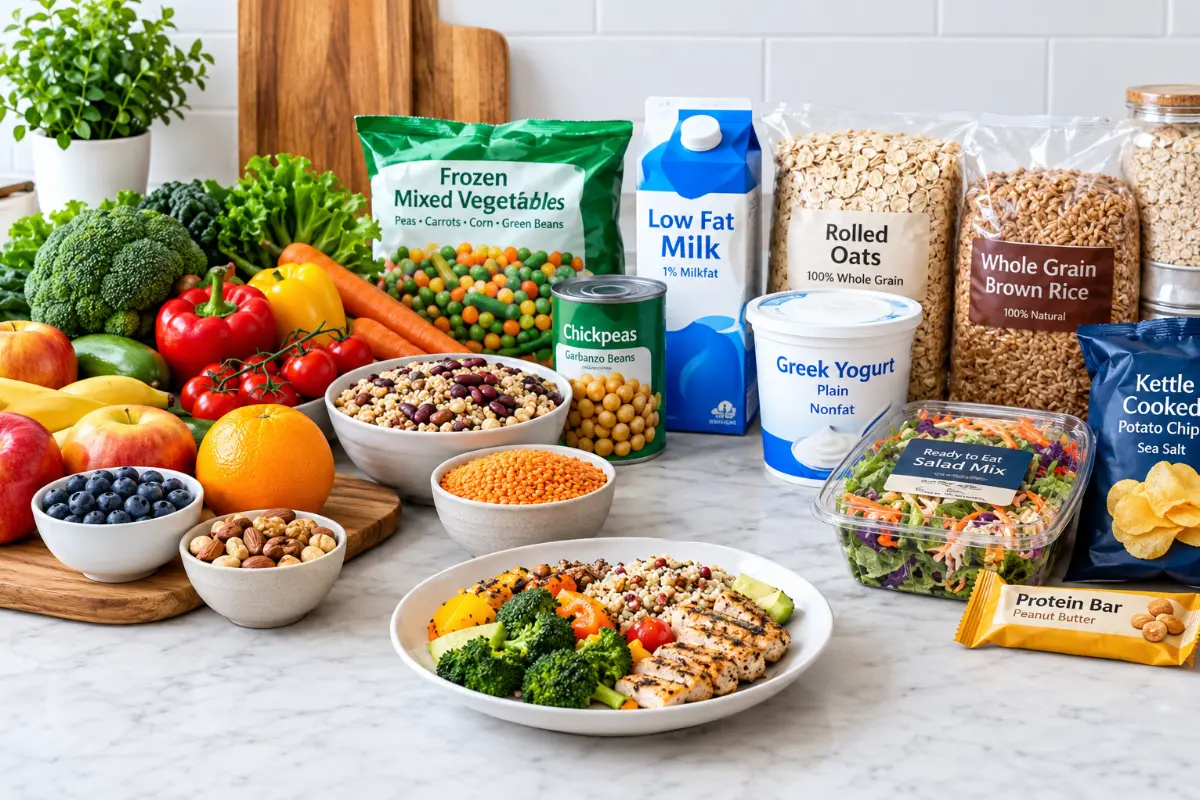
Processed food is not automatically bad for you. Frozen peas, canned beans, pasteurized milk, and plain yogurt are all processed, and all of them are good for you. The health concern sits with a narrower group called ultra-processed foods, which are industrial formulations built from refined ingredients and additives. Higher intake of those has been linked to heart disease, type 2 diabetes, and early death, and two feeding trials, in 2019 and 2025, suggest at least part of that link is real rather than coincidental.
Why “processed” became a dirty word
Somewhere along the way, “processed” stopped describing what happened to a food and started describing whether you should feel guilty about eating it. All food processed is not bad. Freezing is processing. So is milling wheat, pasteurizing milk, drying lentils, and canning tomatoes. If you drew a line at “unprocessed,” you’d be left with raw fruit, raw vegetables, nuts, and raw meat, which is not a diet anyone recommends.
So, ask better questions. What was done to this food? What went in, and what came out? And what is it actually doing in my diet?
What counts as a processed food?
A processed food is any food changed from its original state by physical, biological, or chemical means.
That covers a lot of ground, and most of it is useful. Processing keeps food safe, stops it from rotting, gets it from a farm to a city, and makes it edible. It also lets us fix deficiencies at a population scale, like iodized salt has essentially eliminated iodine deficiency disorders in dozens of countries. Flour fortified with folic acid has cut neural tube defects in babies.
Pasteurizing milk kills the bacteria that used to kill children. That’s processing doing its job.
Processed vs. ultra-processed: what’s the difference?
The difference is scale and intent. Processed foods are recognizable foods with a few ingredients added. Ultra-processed foods are industrial formulations built largely from refined substances and additives, designed to be convenient, cheap, shelf-stable, and very easy to eat.
The framework most researchers use is NOVA, developed by Carlos Monteiro’s team at the University of São Paulo. It sorts food by how much processing it’s had, not by its nutrients.
| NOVA group | What’s in it? | Examples |
| 1. Unprocessed or minimally processed | Foods altered only to make them safe, edible, or storable. Nothing added. | Fresh and frozen produce, eggs, pasteurized milk, plain yogurt, dried beans, rice, oats, plain flour, plain pasta, nuts, fresh meat, and fish |
| 2. Processed culinary ingredients | Substances pressed or extracted from group 1 foods, used for cooking | Cooking oils, butter, salt, sugar, honey, vinegar, starches |
| 3. Processed foods | Group 1 foods with group 2 ingredients added. Still recognizable. | Canned beans, canned fish in oil, most cheese, traditional bread, salted nuts, cured meats |
| 4. Ultra-processed foods | Industrial formulations with ingredients you’d never keep in a kitchen cupboard | Soft drinks, packaged snacks, confectionery, instant noodles, most supermarket sliced bread, reconstituted meat, most ready meals |
People confuse up here. The boundaries are genuinely fuzzy. NOVA ignores nutrition entirely, which is how a whole meal loaf and a chocolate bar end up in the same box.
Use NOVA as a lens. Don’t use it as a verdict.
How do you spot an ultra-processed food?
Look at the ingredients list and ask whether you’d find those things in a normal kitchen.
Protein isolate, malt dextrin, high-fructose corn syrup, hydrogenated fat, emulsifiers, colorings, flavorings, and non-sugar sweeteners are all industrial ingredients. They exist to make cheap raw materials taste, look, and feel like something you’d want to eat and to keep it that way for months.
Then look, is this designed to be eaten straight from the packet, with no preparation and no waiting?
That’s a rough test, not a rule. An additive on its own tells you very little. Preservatives are the reason some foods are safe at all, and ascorbic acid on a label is just vitamin C. Judge the whole product, not the syllable count.
So, are processed foods unhealthy?
No, and lumping them together is the mistake that makes this whole conversation useless. Here’s the spread.
- Frozen vegetables are washed, cut, and frozen, often within hours of picking. Because of that timing, they sometimes hold more vitamin C than “fresh” produce that spent a week in a lorry and three days in your fridge. They’re also cheap, and there’s no waste.
- Canned beans give you protein, fiber, iron, folate, and potassium for very little money. Rinse them and you lose most of the added sodium.
- Plain yogurt is milk changed by bacteria. Nobody has ever made a serious case that this makes it worse than milk.
- Wholegrain bread needs milling, mixing, proving, and baking. Depending on the recipe, it’s a solid source of fiber and B vitamins.
Every item on that list is processed. WHO’s healthy diet guidance is built around a variety of minimally processed and unprocessed foods, with limits on free sugars, unhealthy fats, and salt. It doesn’t tell anyone to avoid processing.
Why are ultra-processed foods a health concern?
Because of how they’re built, what they crowd out, how fast people eat them, and what happens to food when you dismantle its structure. Researchers are still arguing about which of these matters most.
- They’re formulated to a price. Cheap, stable and irresistible usually means high in free sugars, sodium, saturated fat and calories, and low in fiber. Build a diet on that and hitting your nutrient targets becomes arithmetic you can’t win.
- They’re eaten fast. Ultra-processed food tends to be soft, dense, and quick to chew. Studies on eating rate keep finding the same thing. Food you eat faster is food you eat more of, because fullness signals arrive late. This is one of the stronger candidate explanations, and it’s being tested directly right now.
- The structure has been destroyed. An apple and a glass of apple-derived sugar both come from apples, and your body does not treat them alike. Intact plant cell walls and dairy structures change how fast you digest, how full you feel, and how much fiber reaches your gut.
- Some additives are under fresh scrutiny. Certain emulsifiers and sweeteners are being studied for effects on the gut lining and microbiome. Human evidence is still thin, so treat this as a live question rather than a settled one. WHO did advise in 2023 against using non-sugar sweeteners for weight control, on the grounds that they don’t seem to reduce body fat long-term? That was a conditional recommendation based on low-certainty evidence, and it doesn’t apply to people with existing diabetes.
What does the research actually say?
A 2024 umbrella review in The BMJ pooled 45 separate meta-analyses covering about 9.9 million people. Higher ultra-processed food intake was directly associated with 32 of the 45 health outcomes examined, across mortality, cancer, cardiovascular, metabolic, respiratory, gastrointestinal, and mental health.
Almost all of this is observational, which means people who eat more ultra-processed food also tend to smoke more, earn less, exercise less, sleep worse, and eat fewer vegetables.
Two controlled trials now exist, and that matters.
In 2019, Kevin Hall’s team at the US National Institutes of Health locked 20 adults in a research ward for a month. Two diets, two weeks each, matched for calories, sugar, fat, fiber, and sodium; eat as much as you like. On the ultra-processed diet, people ate roughly 500 calories more per day and gained weight. On the minimally processed one, they lost it. Since the nutrients matched, something else was doing the work.
In August 2025, a UCL team led by Samuel Dicken published a longer, more realistic version in Nature Medicine. Fifty-five adults with overweight or obesity ate two eight-week diets in random order, both following the UK Eatwell Guide, one built from ultra-processed food and one from minimally processed food, delivered to their homes. Both diets caused weight loss because they used both beats of what participants normally ate. But the minimally processed diet produced about twice as much: 2.06% of body weight versus 1.05%, roughly a kilo apart over eight weeks, with more fat lost and better control over cravings. Higher ultra-processed food intake is reliably associated with worse health across millions of people.
The rules are about to change
In July 2025, the FDA and USDA opened a joint request for information aimed at creating the first federal definition of “ultra-processed food.” Their own estimate around 70% of packaged products in the US food supply would qualify, and American children get more than 60% of their calories from them.
The 2025-2030 Dietary Guidelines for Americans landed on 7 January 2026. They tell people to avoid highly processed packaged, prepared, and ready-to-eat foods that are salty or sweet and to limit artificial flavors, petroleum-based dyes, artificial preservatives, and low-calorie sweeteners.
Does “natural” mean healthy
Honey is natural, and it’s still a free sugar. Coconut oil is natural, and it’s still about 90% saturated fat. Meanwhile, canned sardines are processed, and they’re one of the best things you can eat.
When you’re actually assessing a food, these are the questions that payoff:
- What does it give me nutritionally?
- How much added or free sugar?
- How much salt?
- What kind of fat, and how much?
- How much fiber?
- Will it fill me up for the calories?
- What’s a realistic portion, not the one on the pack?
- How often will I eat this?
- What is it replacing?
- How does it fit what I eat the rest of the week?
Are food additives dangerous?
The answer deserves more than a flat denial. Everything is chemicals, including water and vitamin C. Additives are assessed one by one by bodies like the Joint FAO/WHO Expert Committee on Food Additives, EFSA, and the FDA, which set acceptable daily intakes from toxicology data and revisit them as evidence accumulates. Approvals do get pulled.
The practical takeaway hasn’t changed: judge a food by its nutrition and its role in your diet, not by how unfamiliar its ingredients sound.
Processed meat is the real exception
Processed meat needs its own section, because the evidence here is older and stronger than anything in the ultra-processed food debate, and because people constantly confuse the two.
In 2015, the International Agency for Research on Cancer, part of WHO, reviewed more than 800 studies and classified processed meat as carcinogenic to humans, Group 1, on sufficient evidence that it causes colorectal cancer. Red meat came out as Group 2A, probably carcinogenic. Processed meat means anything preserved by salting, curing, smoking, or fermentation: bacon, ham, salami, sausages, hot dogs, and deli meat.
The headline figure was that each 50 g daily portion raises the relative risk of colorectal cancer by about 18%. Fifty grams is two rashers of bacon.
How to read a food label in 30 seconds
Five things. That’s it.
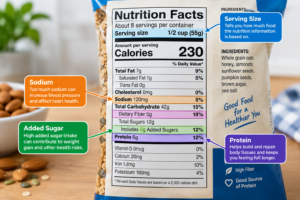
- Serving size first. Everything else on the panel depends on it, and manufacturers are creative here. A bag that looks like one snack is often two and a half servings.
- Sugar. You want added or free sugars, not total sugars, because the sugar in plain milk and whole fruit behaves differently. WHO recommends keeping free sugars under 10% of your daily calories, with extra benefit below 5%?
- Salt. Packaged food, bread, and processed meat dominate salt intake in most countries. WHO says under 5 g of salt a day, which is under 2 g of sodium? Labels use one or the other, so check which. Sodium times 2.5 gives you salt.
- Fiber. Between two products with similar calories, the higher-fiber one is almost always the better buy.
- Protein and nutrient density. Look at what you’re getting, not just what you’re avoiding. No single number should decide it.
What to limit instead
Forget packaging. Focus on products that routinely hand you a lot of free sugar, salt, saturated fat, or industrial trans-fat with very little else.
In practice that’s sugary drinks and energy drinks, confectionery, sweet bakery goods, salty packet snacks, processed meat, instant noodles, and ready meals heavy in salt and saturated fat.
Trans fats deserve a line of their own. WHO wants intake below 1% of total energy and has been pushing to eliminate industriatrans fatced trans-fat globally? Many countries have banned or capped partially hydrogenated oils, but they’re still common in baked margarine, margarines, and fried snacks where regulation lags, including parts of South Asia. Look for “partially hydrogenated oil” or Vanaspati on the label.
Swaps that don’t require a new lifestyle
- Instead of sugary drinks: water, unsweetened tea, sparkling water, water with lemon or mint, and plain lassi.
- Instead of a daily packaged sweet: fruit, yogurt plain yoghurt with fruit, nuts, and seeds.
- Instead of an instant meal by default: rice with dal and a vegetable. Wholegrain toast with eggs. Yoghurt with oats, fruit, and nuts. Chickpeas with onion, tomato, and spice.
Fifteen minutes, no technique required.
Upgrade, don’t eliminate
The people who succeed at this don’t cut things out. They trade up.
- Breakfast: swap a sweetened cereal with yogurt, it, and nuts, or eggs on wholegrain toast.
- Snack: swap the big bag of crisps for fruit with unsalted nuts or roasted chana.
- Lunch: keep the convenience, change the base. Rice or wholegrain, beans or lentils, vegetables, and a protein.
- Dinner: build around vegetables, a protein, and a minimally processed carbohydrate.
You’re not aiming for a perfect diet. You’re aiming for one where the nutritious stuff is the foundation and the convenient stuff is in proportion. If you only change one thing, cut the sugary drinks. They cost real money and give you nothing.
Children and ultra-processed food
The numbers here are the reason regulators are moving. US agencies estimate children get more than 60% of their calories from ultra-processed products. The UK is in similar territory, and intake is climbing fast across South Asia, Latin America, and the Middle East as these products push out traditional diets.
Children are also the primary target of food marketing, which is why policy attention has shifted towards advertising restrictions.
Can you avoid ultra-processed food completely?
For most people, no, and chasing it isn’t worth the effort. What you eat is shaped by money, time, what’s near you, who you’re feeding, what kitchen you have, and what culture you grew up in.
Myths worth retiring
- “All processed food is unhealthy.” Processing runs from freezing peas to engineering a snack bar. Frozen vegetables, pasteurized milk, canned beans, and plain yogurt are all processed and all good.
- “All additives are harmful.” They’re assessed individually and serve different jobs. Some of them are the reason your food is safe.
- “Fresh always beats frozen and canned.” Frozen produce is often frozen within hours of harvest and can hold more vitamin C than fresh produce that’s been in storage for a week. WHO explicitly says frozen and canned fruit and vegetables are good choices when they don’t carry added sugar or excess salt?
- “Ultra-processed food is proven to cause chronic disease.” The association is well established. Two trials now suggest a causal contribution to how much people eat. But most of the observational evidence is low certainty, and the trials are small and short. “Proven to cause disease” goes well past what anyone has shown.
- “Chemical-sounding” means dangerous. Ascorbic acid is vitamin C. Dihydrogen monoxide is water. What matters is which substance, how much, and what the safety data say.
- “Ultra-processed just means unhealthy.” NOVA classifies by processing, not nutrition. Whole meal sliced bread, plain soy milk, and some fortified cereals sit in group 4 next to sweets. That’s one of the main criticisms of the system.
- “You need to eliminate packaged food.” Packaged food delivers convenience, affordability, safety, preservation, and, in fortified products, nutrients that are otherwise hard to get.
It comes down to the pattern
A diet isn’t a food. It’s the same handful of meals eaten over and over for years.
A pattern built on vegetables, fruit, legumes, whole grains, nuts, and decent protein can absorb plenty of convenient packaged food without becoming unhealthy. A pattern built on soft drinks, packet snacks, and ready meals will struggle no matter how carefully you pick between brands.
So, build the base well and keep the highly processed stuff in proportion, paying most attention to the things loaded with free sugar, salt, saturated fat, or industrial trans-fat.
Frequently asked questions
Q1: What are processed foods?
Processed foods have been changed from their natural state by physical, biological, or chemical means, including freezing, cooking, drying, fermenting, canning, milling, and packaging. Processing runs along a spectrum, so processed foods vary enormously in how nutritious they are.
Q2: Are processed foods bad for you?
Not as a category. Frozen vegetables, canned beans, plain yogurt, and pasteurized milk are all processed and all nutritious. The health concerns attach to diets dominated by highly processed products high in sugar, salt, or unhealthy fats and low in everything else.
Q3: What is an ultra-processed food?
Under the NOVA system, an ultra-processed food is an industrial formulation made through multiple processing steps from refined substances and additives, typically containing ingredients you wouldn’t find in a home kitchen. Soft drinks, packaged snacks, confectionery, instant noodles, and most ready meals qualify.
Q4: Are ultra-processed foods unhealthy?
Higher intake is consistently linked to worse health outcomes across millions of people, and two randomized feeding trials found people ate more and gained more weight on ultra-processed diets than on minimally processed ones. Most of the observational evidence is low certainty, and researchers are still identifying which features of these foods are responsible.
Q5: Should I stop eating all processed food?
No. Make minimally processed and unprocessed foods the base of your diet, and be selective about products consistently high in added sugar, salt, or unhealthy fats.
Q6: Are frozen vegetables processed?
Yes, and they’re classified as minimally processed. Frozen vegetables without added sauce, sugar, or salt are an excellent choice, and they sometimes contain more vitamin C than fresh produce that’s been stored for several days.
Q7: Is canned food unhealthy?
Not inherently. Canning preserves nutrients well and extends shelf life. Check for added sugar and salt, and rinse canned beans and vegetables if you’re watching sodium.
Q8: Is bread ultra-processed?
It depends on the bread. Traditional bread made from flour, water, yeast, and salt is a processed food (NOVA group 3). Most mass-produced sliced bread contains emulsifiers and preservatives and counts as ultra-processed. Whether a given loaf is a good choice comes down to its fiber, salt, and sugar content.
Q9: Is processed meat the same as processed food?
No, and confusing the two causes a lot of bad advice. Processed meat is a specific category that IARC classifies as carcinogenic to humans based on colorectal cancer evidence. It tells you nothing about frozen vegetables or canned beans.
Q10: Does processed meat cause cancer?
IARC classified processed meat as a Group 1 carcinogen in 2015, meaning there’s sufficient evidence it causes colorectal cancer. Each 50 g eaten daily raises relative risk by about 18%, which moves a roughly 5% lifetime risk to around 6%. Group 1 reflects certainty, not severity.
Q11: What should I look for on a food label?
Serving size, added or free sugars, salt or sodium, saturated fat, fiber, and protein, roughly in that order.
Q12: Are food additives safe?
Approved additives are assessed individually for safety and given acceptable daily intake limits. The presence of an additive doesn’t make a food unhealthy, though some classes, particularly emulsifiers, are under fresh research scrutiny.
Q13: What’s the healthiest way to eat?
No single food makes a diet healthy. Healthy patterns emphasize variety, adequacy, balance, and moderation, built on vegetables, fruit, legumes, whole grains, nuts, and decent protein sources.
Key takeaways
- Processed does not mean unhealthy. Freezing, pasteurizing, milling, and canning all make food safer, cheaper, or more nutritious.
- Ultra-processed food is a much narrower category, defined by industrial formulation rather than by nutrient content.
- Higher ultra-processed food intake is associated with a wide range of poor health outcomes, with convincing evidence for cardiovascular mortality, type 2 diabetes, and common mental disorders.
- Most of that evidence is low certainty, but randomized trials in 2019 and 2025 both found people ate more and fared worse on ultra-processed diets.
- Processed meat is a separate and stronger case, classified by IARC as carcinogenic to humans.
- NOVA is a useful lens with real flaws, including inconsistent coding and total indifference to nutrition.
- A US federal definition of ultra-processed food went for final review in August 2026, with front-of-pallet labeling likely to follow.
- The overall pattern of your diet matters far more than any single packaged food.
Conclusion
Food processing isn’t good or evil. It’s a set of techniques that can keep food safe, make it affordable, put vegetables on your table in winter, and, at the far end, turn commodity starch and oil into something engineered to be eaten quickly and in quantity.
Here’s what holds up. Build your diet on vegetables, fruit, legumes, whole grains, nuts, and good protein. Use the processed foods that make that easier, because there are plenty. Be choosier about products engineered around sugar, salt,, and fat, and about processed meat specifically. Read labels for what’s in the food rather than how the words sound.
Aim for a diet that’s nutritious,varied,d and actually workable in your life. Not a perfectly unprocessed one.
Sources
- Lane MM, et al. Ultra-processed food exposure and adverse health outcomes: an umbrella review of epidemiological meta-analyses. BMJ 2024;384: e077310. https://www.bmj.com/content/384/bmj-2023-077310
- Hall KD, et al. Ultra-processed diets cause excess calorie intake and weight gain. Cell Metabolism 2019. https://pubmed.ncbi.nlm.nih.gov/31105044/
- Dicken SJ, et al. Ultra-processed or minimally processed diets following healthy dietary guidelines on weight and cardiometabolic health: a randomized, crossover trial. Nature Medicine 2025; 31:3297-3308. https://www.nature.com/articles/s41591-025-03842-0
- Correspondence on the above. Nature Medicine 2026. https://www.nature.com/articles/s41591-025-04087-7 and https://www.nature.com/articles/s41591-025-04088-6
- Monteiro CA, et al. The UN Decade of Nutrition, the NOVA food classification, and the trouble with ultra-processing. Public Health Nutrition 2018.
- IARC/WHO. Q&A: carcinogenicity of the consumption of red meat and processed meat. https://www.who.int/news-room/questions-and-answers/item/cancer-carcinogenicity-of-the-consumption-of-red-meat-and-processed-meat
- IARC press release 240, October 2015. https://www.iarc.who.int/wp-content/uploads/2018/07/pr240_E.pdf
- WHO? Healthy diet fact sheet. https://www.who.int/news-room/fact-sheets/detail/healthy-diet
- WHO? Use of non-sugar sweeteners: WHO guideline, 2023. https://www.who.int/news/item/15-05-2023-who-advises-not-to-use-non-sugar-sweeteners-for-weight-control-in-newly-released-guideline
- USDA/FDA press release, July 2025. https://www.usda.gov/node/64926
- FDA Human Foods Program 2026 Priority Deliverables. https://www.fda.gov/about-fda/human-foods-program/human-foods-program-2026-priority-deliverables

Saba Shafique is a Content Writer at ITZ Magazine, creating clear, informative, and reader-friendly content covering health, fitness, wellness, nutrition, and healthy living. She focuses on making complex topics easy to understand while providing practical information readers can use in everyday life.

One thought on “Processed Foods Exposed: Separating Deadly Myths From Dangerous Facts””