Your gut does far more than digest your lunch. It breaks food into nutrients your body can use, while the roughly 38 trillion microorganisms living mostly in your intestine shape digestion, metabolism, and immune function. Around 70% of your immune tissue is thought to sit in the gut.
Here’s the honest truth: good gut health rarely comes from an expensive supplement or a weekend “detox.” What works is far less glamorous. The American Gut Project found that people who ate 30+ different plants per week had more diverse microbiomes than those who ate 10 or fewer. Yet the average American gets only about 15 grams of fiber daily, well below the 25-38 grams recommended by the Dietary Guidelines for Americans. Add enough water, regular movement, and 7+ hours of sleep, and you’ve covered most of the basics.
And listen to your body. Persistent bloating, changes in bowel habits, or unexplained weight loss are worth raising with a doctor or registered dietitian.
What Is Gut Health?
Gut Health is a broad term for how well your digestive system is functioning and how balanced its microbial community is.
A well-functioning gut needs to be able to:
- Digest food effectively
- Absorb nutrients
- Move food and waste through the digestive tract
- Maintain a proper intestinal barrier
- Support the back-and-forth between your immune system and gut microorganisms
- Keep its microbial ecosystem in balance
Gut Health isn’t the same as never having digestive symptoms
Everyone gets gas, bloats occasionally, or has an off week with constipation or diarrhea. That’s normal.
What actually matters is whether symptoms are persistent, severe, getting worse, or interfering with your day-to-day life. Occasional discomfort isn’t a red flag. A pattern is.
Signs of an Unhealthy Gut
Most people don’t think much about their gut until something feels wrong—and even then, it’s easy to miss that the gut is involved at all, because an unhealthy gut doesn’t always show up as a stomachache.
A few of the more common signs:
- Digestive discomfort that keeps coming back. Bloating, gas, constipation, diarrhea, or heartburn that shows up regularly not just after one heavy meal—is usually the clearest signal that digestion isn’t running smoothly.
- Low energy or restless sleep. This one surprises people. Roughly 90 to 95% of the body’s serotonin, a chemical tied to both mood and sleep regulation, is produced in the gut rather than the brain. When gut function is off, sleep and energy can be too.
- Skin flare-ups. Acne, eczema, and general skin irritation have been linked to gut inflammation in research, though skin issues obviously have plenty of other causes as well.
- New food intolerances or intense cravings. Suddenly struggling with foods you used to handle fine, or noticing stronger-than-usual sugar cravings, can sometimes point to a shift in your gut’s bacterial balance.
- Weight changes you can’t explain. When digestion and nutrient absorption aren’t working the way they should, weight can drift in either direction without an obvious cause.
- Getting sick more than usual. A large share of the body’s immune cells lives in the gut lining, so ongoing gut trouble can overlap with catching colds more easily or feeling run-down more often.
None of these signs proves anything on its own—most of them have other explanations too. But if several are showing up together, and they’re sticking around, that’s worth a conversation with a doctor rather than a guessing game.
The Gut Microbiome Explained
The gut microbiome is the community of microorganisms living in your gastrointestinal tract.
These microbes interact with the food you eat and produce substances that ripple out into the rest of the body. NIDDK-supported research has found that changing your diet can actually shift the composition and function of the gut microbiome. (NIDDK) That’s a big part of why diet matters so much here.
Why Gut Health Matters
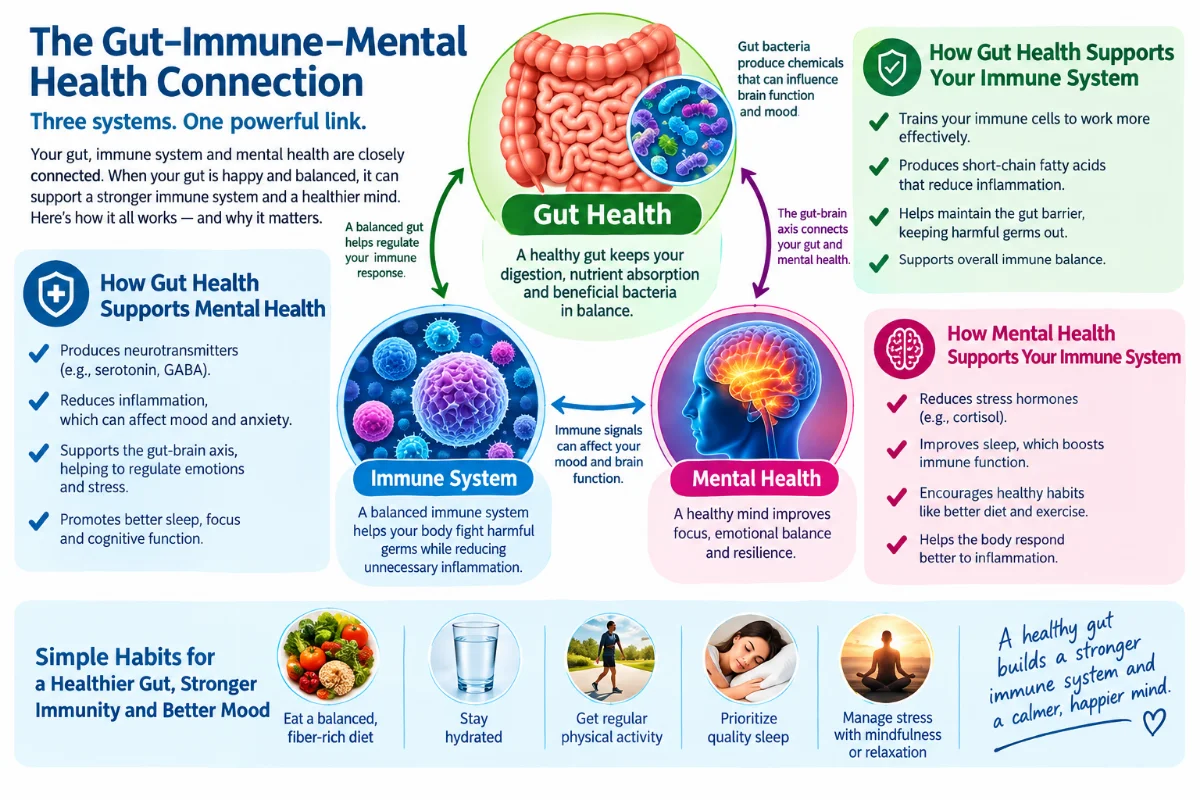
Your digestive system isn’t an isolated organ it’s wired into several other systems in your body.
1. Digestion and nutrient absorption
The digestive tract breaks carbohydrates, proteins, and fats down into pieces small enough to absorb and use for energy, growth, and repair.
2. Immune function
The gastrointestinal tract and the immune system are in constant contact. In fact, a large share of the body’s immune cells sits in and around the gut lining, which is one reason gut health and immune research overlap so much.
3. Metabolic health
Diet, gut microbes, and metabolism interact for metabolic health. Human studies have shown that shifting toward more fiber and fewer heavily processed foods can change microbiome composition and function.
4. Gut-brain communication
The gut and the nervous system talk to each other constantly through several different biological pathways this is often called the gut-brain axis, and it’s an active area of research into digestion, mood, and overall health.
The Best Foods for Gut Health
There’s no single miracle food for a healthy gut.
What actually helps is variety a wider range of plants means a wider range of fiber types feeding a wider range of microbes.
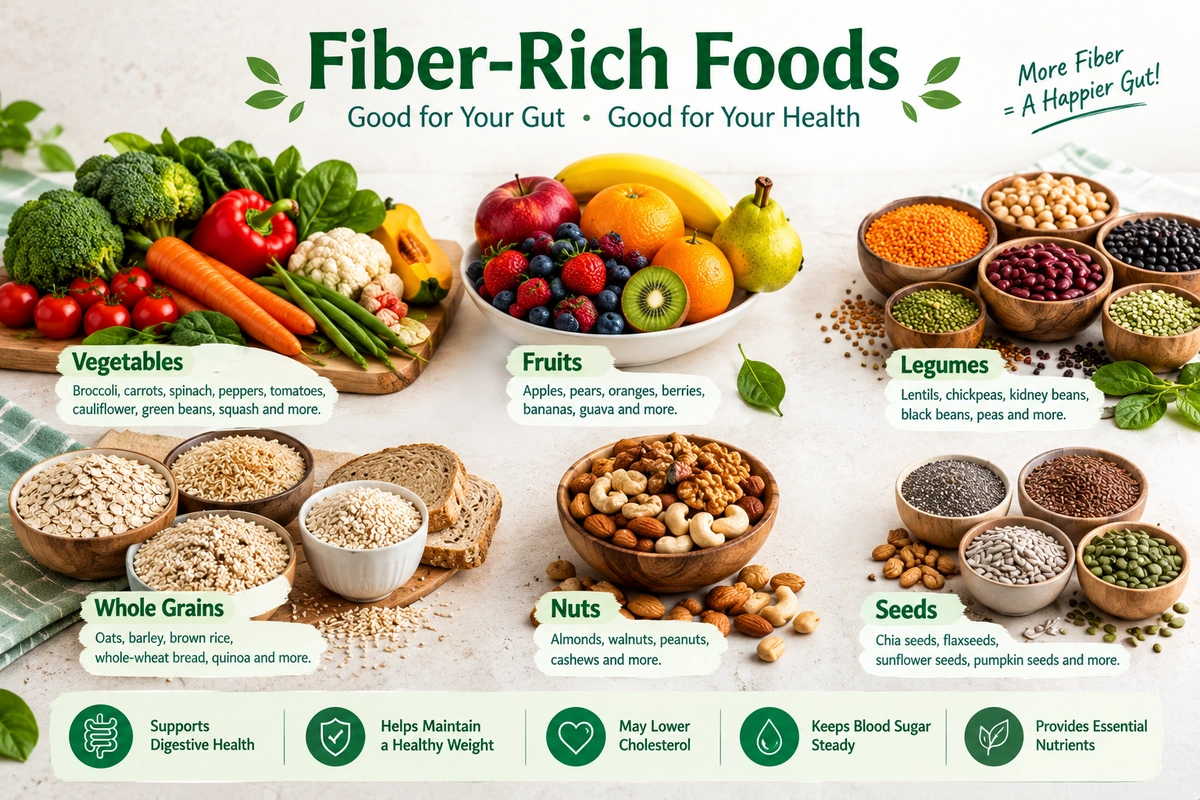
1. Vegetables
Mix up the types and colors on your plate:
- Broccoli
- Carrots
- Spinach
- Peppers
- Tomatoes
- Cauliflower
- Green beans
- Squash
Different vegetables bring different fibers and nutrients to the table, which is the whole point.
2. Fruits
Whole fruit adds fiber along with a range of other nutrients.
A few good options:
- Apples
- Pears
- Oranges
- Berries
- Bananas
- Guava
If you’re ramping up your fiber intake, do it gradually your gut will thank you.
3. Beans and lentils
Legumes pull double duty: fiber and plant protein in one food.
- Lentils
- Chickpeas
- Kidney beans
- Black beans
- Peas
- Soybeans
- Whole grains
- Oats
- Barley
- Brown rice
- Whole-wheat bread
- Whole-grain pasta
4. Nuts and seeds
Beyond fiber, these bring healthy fats and other nutrients into the mix.
- Almonds
- Walnuts
- Peanuts
- Chia seeds
- Flaxseeds
How Much Fiber Do You Need?
Fiber needs shift depending on your age and sex.
For adults, NIDDK puts the general target at roughly 22–34 grams per day. (NIDDK)
Kids and teens have different needs entirely, so it’s not a case of simply scaling the adult number down.
1. Increase fiber gradually.
Going from a low-fiber diet straight to a high-fiber one overnight tends to backfire—think gas, bloating, and general abdominal discomfort.
Easing into it, and drinking enough water along the way, makes the whole transition a lot more comfortable. (NIDDK)
2. Prebiotics vs. Probiotics: What’s the Difference?
These two terms get used almost interchangeably, but they’re not the same thing.
| Term | What it means | Examples |
| Probiotics | Live microorganisms that can provide health benefits when consumed in adequate amounts | Certain strains in fermented foods or supplements |
| Prebiotics | Nondigestible food components that can be used by beneficial microorganisms | Certain plant fibers |
| Synbiotics | Combinations of probiotics and prebiotics | Specific products or formulations |
3. Don’t assume “more probiotics = better Gut Health.
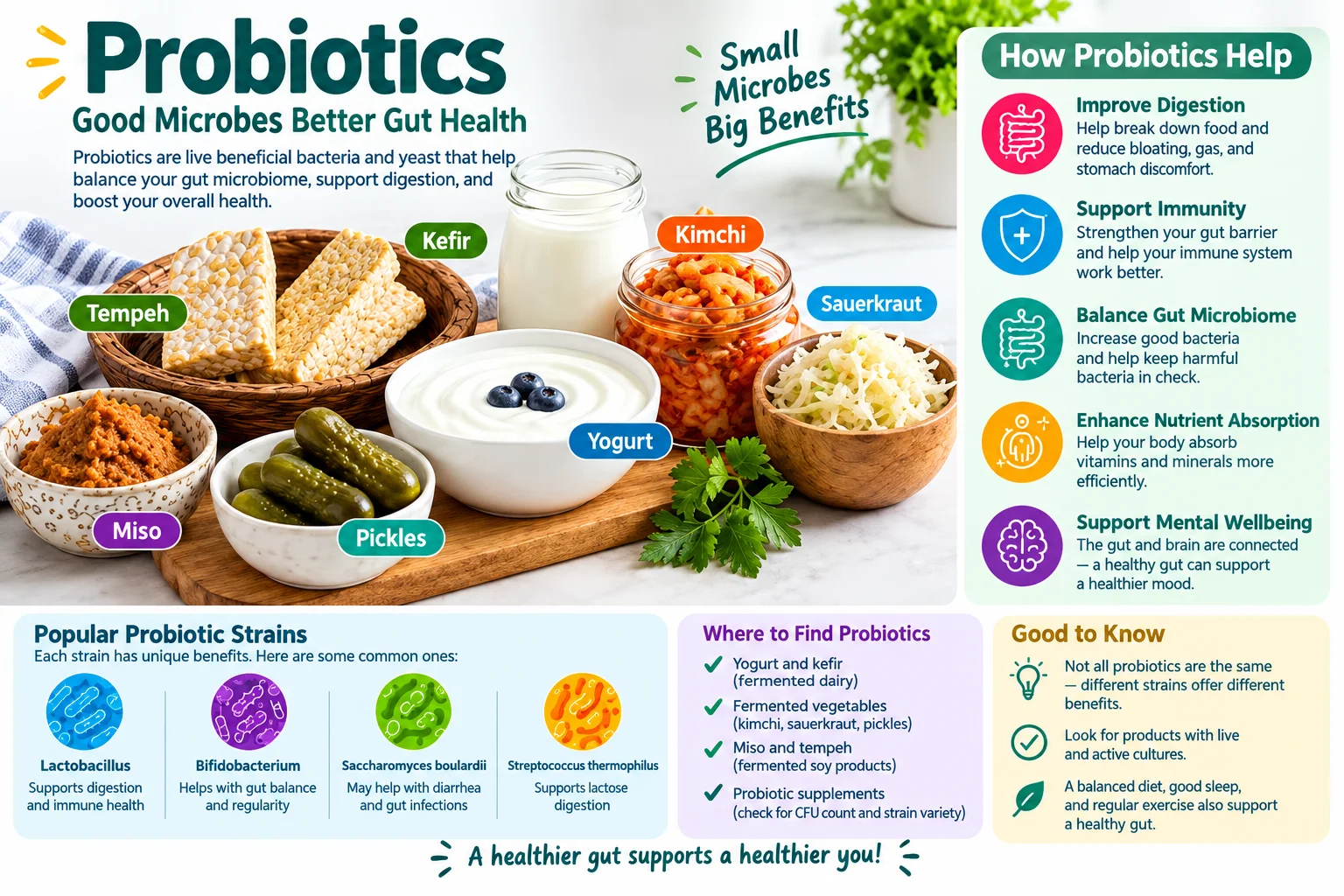
Probiotic research is strain-specific, almost stubbornly so. Evidence that a strain helps with one condition doesn’t automatically mean it helps with another. (NCCIH)
So, grabbing a random probiotic off the shelf isn’t necessarily the smartest first move if you’re just trying to feel better generally.
Fermented Foods and Gut Health
Fermented foods worth knowing about include:
- Yogurt
- Kefir
- Some fermented vegetables
- Kimchi
- Sauerkraut
- Miso
Here’s the catch, though: Fermented doesn’t automatically mean probiotic.
Microorganisms are often involved in making fermented foods, but that doesn’t guarantee the finished product contains microbes with proven probiotic benefits. Eat the fermented foods you enjoy—just don’t treat them like medicine.
Gut Health and Water
Fluids matter more than people give them credit for, especially once you start increasing fiber.
Fiber helps soften stool and make it easier to pass, but it needs water to do that job properly. (NIDDK)
Plain water is genuinely the simplest, most effective choice here—no “detox water” required.
Gut Health and Physical Activity
Your digestive system doesn’t operate in a vacuum; it responds to what the rest of your body is doing.
Regular movement supports overall health and can specifically help relieve constipation—NIDDK lists physical activity among the measures that help. (NIDDK)
For younger people especially, movement that’s actually fun—walking, cycling, swimming, dancing, team sports—beats exercise framed purely around burning calories or changing how you look.
Sleep, Stress, and the Gut
The gut and the nervous system talk in both directions, which is why stress can show up in your stomach and stomach trouble can leave you stressed.
For something like IBS, NIDDK points to a mix of physical activity, cutting down on avoidable stress, better sleep, dietary changes, and appropriate medical treatment as useful approaches. (NIDDK)
To be clear, this isn’t “it’s all in your head.” The connection between the nervous system and the gut is a real, physical one.
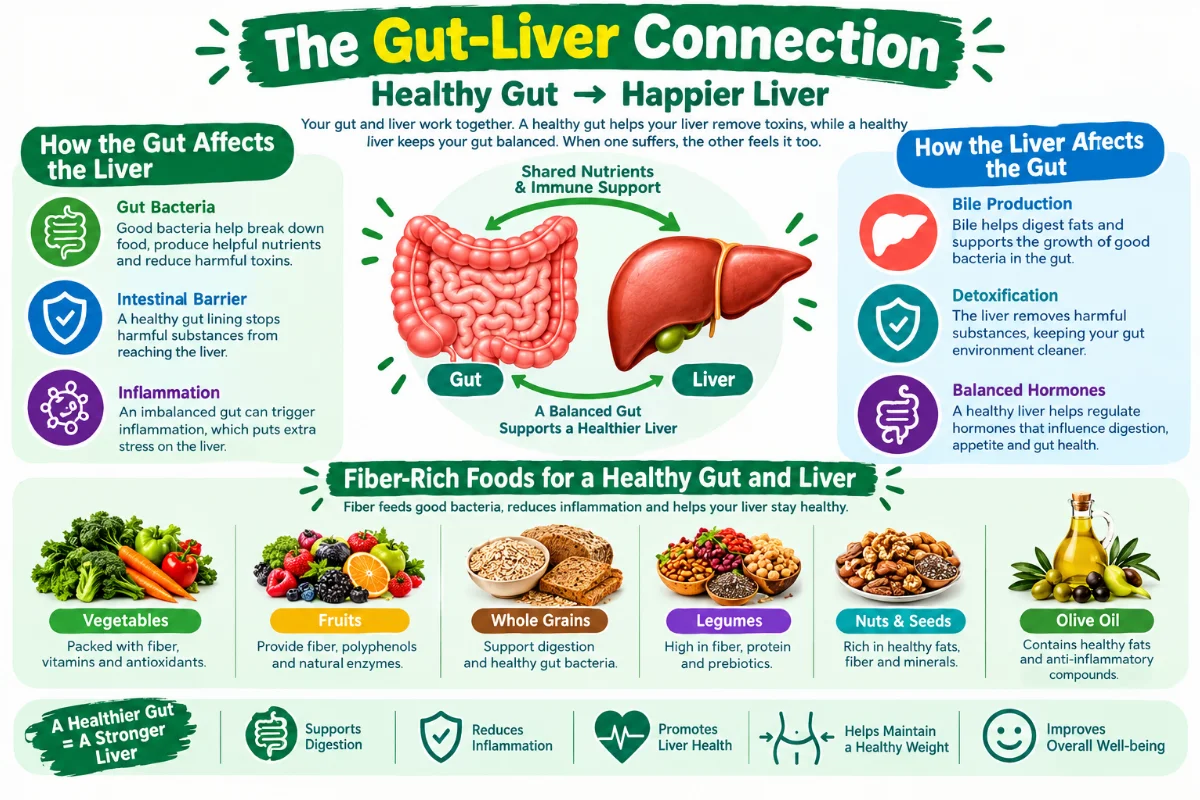
Gut Health and the Liver
The gut and liver stay in touch through what’s called the gut-liver axis—ongoing communication between the gastrointestinal tract, its microbes, and the liver.
That relationship runs through:
- Nutrients
- Microbial metabolites
- Bile acids
- Immune signaling
- Intestinal barrier function
What Can Harm Gut Health?
There’s no universal blacklist of foods everyone needs to avoid—digestive responses are genuinely individual.
A few patterns tend to make digestive trouble more likely:
- Very low-fiber eating patterns
- Heavy reliance on highly processed foods
- Not drinking enough fluids
- Sudden, drastic dietary changes
- Eating foods that personally trigger your symptoms
- Certain medications or supplements.
A Simple Gut-Friendly Meal Formula
Forget the elaborate meal plan. A simple formula works fine:
1. Plant food + fiber-rich carbohydrate + protein + healthy fat
Aim for variety and balance—not infection.
2. A Practical 7-Day Gut Health Habit Plan
Skip the restrictive “gut reset.” Try building one habit a day instead.
| Day 1 | Add a vegetable to one meal. |
| Day 2 | Choose a whole-grain food. |
| Day 3 | Add beans or lentils |
| Day 4 | Eat a variety of whole fruits. |
| Day 5 | Drink water regularly. |
| Day 6 | Get enjoyable physical activity. |
| Day 7 | Notice which foods leave you feeling comfortable and energized. |
Common Gut Health Myths
Myth 1: “You need a gut detox.”
Not true. Your body already handles this—a commercial cleanse isn’t required to maintain a healthy gut. A balanced diet and appropriate medical care do the actual work.
Myth 2: “Everyone needs probiotics.”
Not quite. Probiotic effects depend heavily on the specific microorganism, strain, dose, and condition being targeted. The evidence doesn’t support the idea that everyone benefits from taking one. (NCCIH)
Myth 3: “All bacteria are bad.”
Far from it. Your gut hosts a complex microbial community, and plenty of those microorganisms actively support digestion and other essential functions. (NIDDK)
Myth 4: “Bloating always means your gut is unhealthy.”
Not necessarily. Occasional bloating happens for all kinds of reasons. It’s the persistent or severe cases that deserve a closer look.
Myth 5: “You should eliminate gluten for better gut health.”
Only in specific cases. Gluten avoidance is medically necessary for conditions like celiac disease—but there’s no blanket rule that everyone benefits from cutting it out.
Myth 6: “More fiber is always better.”
Not exactly. Fiber matters, but piling on very large amounts too quickly can trigger gas and bloating instead of helping. The right amount depends on the person. (NIDDK)
When Should You Talk to a Doctor?
Don’t assume persistent digestive symptoms are just a microbiome quirk; you can eat your way out of it.
Get medical advice if symptoms are persistent, severe, getting worse, or interfering with your daily life. That includes:
- Ongoing abdominal pain
- Persistent diarrhea
- Persistent constipation
- Repeated vomiting
- Blood in the stool
- Unexplained weight changes
- Difficulty swallowing
- Significant or persistent bloating
- Symptoms that wake you up at night, repeatedly
A healthcare professional can figure out whether what you’re experiencing relates to IBS, a food intolerance, inflammatory bowel disease, an infection, celiac disease, a medication side effect, or something else entirely.
Frequently Asked Questions
Q1: What is the fastest way to improve gut health?
There’s no single overnight fix, honestly. The most reliable starting point is gradually adding more variety and fiber to your diet, drinking enough water, staying active, and sleeping properly.
Q2: What are the signs of an unhealthy gut?
Common signs include recurring bloating, gas, constipation or diarrhea, low energy, poor sleep, skin flare-ups, new food intolerances, sugar cravings, and unexplained weight changes. One symptom alone doesn’t mean much—a cluster of them, especially if persistent, is worth mentioning to a doctor.
Q3: What foods are best for gut bacteria?
Rather than fixating on one “superfood,” regularly eating a mix of vegetables, fruits, legumes, whole grains, nuts, and seeds gives your gut microbiome a broader range of fiber types and nutrients to work with. (NIDDK)
Q4: Is yogurt good for gut health?
It can be yogurt is nutritious, and some varieties contain live microorganisms. That said, not every yogurt on the shelf has proven probiotic benefits, so check the label rather than assuming.
Q5: Are probiotics necessary?
Not for everyone. Their effects are strain- and condition-specific, and the evidence varies quite a bit. If you’re considering one for a medical condition, it’s worth a conversation with a healthcare professional first.
Q6: Does fiber help digestion?
Yes, fiber supports regular bowel movements and is a core part of a healthy diet. Adults generally need around 22–34 grams a day, though the exact number depends on age and sex.
Q7: Can gut health affect the liver?
It can. The gut and liver stay connected through the gut-liver axis, which involves microbial metabolites, bile acids, immune signaling, and the intestinal barrier—an area researchers are still actively exploring. (NIDDK)
Conclusion
Good gut health was never about chasing a “perfect” microbiome.
It’s about backing your digestive system with a balanced, varied diet and a handful of consistent habits, while accepting that digestive symptoms can come from all sorts of places, not just what you ate.
Start small, eat a wider range of plant foods, add fiber gradually, drink enough water, move your body, sleep properly, and take notes.
The most useful thing to remember here: you don’t need a cleanse, a supplement shelf, or a rigid diet to take care of your gut. You mostly just need consistency.
Please Read More Related Articles: