You walk into the kitchen and stop. Whatever you came in for is gone. You stand there for a few seconds, a little unsettled, then laugh and head back to your desk.
Most of us have done this, and usually it just means a tired, distracted brain. Still, it leaves a small question behind.
Is there something I should be doing to look after my memory?
A quick search gives you endless lists of “superfoods.” But many of them have little proof behind them. When we read the latest trials and guidelines, the biggest surprise is that a bowl of berries matters far less than the overall shape of your daily habits.
This guide sorts what’s promising from what’s proven, and ends with a practical plan you can use without following a rigid diet for a healthy brain.
What changed Healthy Brain advices in 2026?
The biggest development isn’t a new food. On 15 July 2026 the World Health Organization published the second edition of its guidelines on reducing the risk of cognitive decline and dementia, updating the 2019 version.
The new edition takes a wider view than the old one. It covers healthy behaviors, health conditions that raise dementia risk, environmental exposures, and tailored programs that tackle several risk factors at once.
- A healthy, balanced dietary pattern may be recommended to adults with normal cognition or mild cognitive impairment.
- Physical activity should be recommended to adults with normal cognition.
- Vitamins B and E, omega-3 supplements and multivitamins shouldn’t be used specifically to prevent cognitive decline or dementia in people without a diagnosed deficiency.
- Hearing aids, cognitive stimulation and social activity interventions now feature as options to consider.
- WHO notes that up to 45% of dementia risk can be attributed to modifiable factors, many shared with other long-term conditions?
The practical shift is from asking “what’s the best brain food?” to asking “which everyday habits, taken together, give my brain the best chance?”
Which foods are linked to a healthy brain?
No single food does the job. Build most meals around foods that supply fiber, vitamins, minerals and unsaturated fats while keeping your heart and blood vessels healthy. Almost all of the evidence below is observational, meaning it shows a link, not proof that the food caused the benefit.
In the large 2026 dietary-pattern study, the food groups tied to better cognition were more vegetables and fish and less red and processed meat.
1. Leafy greens
In the Rush Memory and Aging Project, 960 older adults (average age 81) who ate about one serving of leafy greens a day showed slower decline on memory and thinking tests than people who rarely ate them. The researchers described the gap as the equivalent of being about 11 years younger cognitively, but they stressed it was an association. A serving was half a cup of cooked spinach, kale or similar greens, or a cup of salad.
Easy ways in spinach with eggs, greens stirred into dal or a lentil soup, a side salad, or sautéed leafy greens next to fish or chicken.
2. Berries and other fruit
Berries are rich in plant compounds called flavonoids. In the Nurses’ Health Study, women who ate at least half a cup of blueberries or a cup of strawberries each week had slower cognitive decline, by up to about 2.5 years. Fresh berries are expensive or hard to find in many places, and you don’t need them. Apples, oranges, guava, pomegranate, papaya and whatever fruit is in season all fit a Healthy Brain Diet pattern.
3. Fish
An older study of a large community sample linked eating fish about once a week with a slower yearly decline in thinking skills. Fish also supplies protein and omega-3 fats, and sardines, salmon, mackerel and trout are all good choices.
Capsules are a different story. In the VITAL trial, 3,424 healthy older adults took omega-3 or placebo for about 2.8 years, and the difference in cognitive change wasn’t significant. Eat the fish if you like it. Don’t expect the supplement to do the same job.
4. Nuts, seeds and olive oil
These sit at the center of Mediterranean, DASH and MIND-style eating and provide unsaturated fats, fiber and protein. Walnuts, almonds, peanuts, pumpkin seeds and flaxseed all work. Because nuts are energy-dense, a small handful in place of a biscuit is the idea, not an extra handful on top of everything else.
5. Beans, lentils and whole grains
These rarely make the “superfood” lists, but they make meals filling, affordable and easy to store. Think dal, chickpeas, kidney beans, oats, barley, brown rice and whole-wheat roti. They also show why a brain-friendly diet doesn’t need imported ingredients.
6. Does the MIND diet actually work?
The MIND diet blends the Mediterranean and DASH diets with a focus on greens, berries, nuts, beans, whole grains, fish and olive oil. For years, observational studies tied closer adherence to it to better cognitive outcomes.

What the 2023 trial found
Then researchers tested it properly. In a randomized trial in the New England Journal of Medicine, 604 older adults with a family history of dementia, excess weight, and a less healthy usual diet followed either the MIND diet or a control diet, and both groups received mild calorie-reduction coaching. After three years, both groups improved slightly on cognitive tests, and the difference between them wasn’t statistically significant. Brain MRI measures didn’t differ significantly either.
That doesn’t prove the diet is useless. The control group also improved its eating and lost weight, which narrowed the contrast, and three years is short for a condition that develops over decades. What the trial does show is that the MIND diet hasn’t been proven to prevent Healthy brain on its own.
What three 2026 studies add
| Study | Who | What it found |
| JAMA Neurology (Feb 2026) | 159,347 adults, average age 44 | Higher adherence to each of six healthy diets was linked with lower risk of self-reported cognitive decline. For DASH, the risk ratio was 0.59, about 41% lower. The link was strongest for eating well at ages 45 to 54. |
| American Journal of Public Health (Jun 2026) | 5,370 older adults, nearly nine years | Highest consumers of ultra-processed food had a 58% higher dementia risk. Those eating the most whole, minimally processed food had a 41% lower risk. |
| Neurol Neurosurgeon Psychiatry (2026) | More than 1,600 adults, about 12 years | Each three-point rise in MIND score was linked to about 20% less grey-matter shrinkage, which the researchers equated to roughly 2.5 years of brain ageing. |
What should you eat less of?
Cutting back matters as much as adding. The foods worth limiting are sugary drinks, processed meats, frequent fast food, packaged sweets and pastries, and refined snacks that crowd out better options.
An earlier JAMA Neurology study of 10,775 people found that the top quarter of ultra-processed food eaters had a 28% faster decline in overall cognition and a 25% faster decline in executive function over about eight years. When overall diet quality was high, that link disappeared. Good food on the plate seems to count, too, for Healthy Brain.
Not everything in a packet is a problem. Frozen vegetables, tinned beans, tinned fish, plain yoghurt and wholegrain cereals can all earn a place. The useful question is what a food adds to your overall diet.
| Instead of this often | Try this more often |
| Sugary drinks | Water, sparkling water, unsweetened tea |
| Biscuits and pastries daily | Fruit, nuts, plain yoghurt |
| Processed meat | Fish, beans, lentils, eggs, chicken |
| Refined snacks | Nuts, fruit, wholegrain options |
| Butter or solid fats for cooking | Olive oil or other unsaturated oils |
| Ready meals most days | Simple dishes built on vegetables, pulses and whole grains |
Which habits beyond food matter for Healthy Brain?
The strongest direct evidence for bundling habits comes from the U.S. POINTER trial: 2,111 older adults at risk of cognitive decline followed a structured or a self-guided program for about two years. Both improved cognition. The structured program, with supervised exercise, MIND-style diet coaching, brain and social activities, and health monitoring, did better.
1. Move regularly
WHO recommends physical activity for adults with normal cognition? For adults 65 and over, earlier WHO guidance set the target at 150 minutes of moderate activity a week. Brisk walking, cycling, swimming and dancing all count. If you’ve been inactive or have a health condition, start gently and ask your doctor.
2. Know your blood pressure, cholesterol and blood sugar
What’s good for your blood vessels is good for your brain. High blood pressure, high LDL cholesterol and diabetes all sit on the modifiable-risk list, so routine checks count as brain care.
3. Protect your sleep
A long-running UK study found that people who slept six hours or less in their 50s, 60s and 70s had about a 30% higher dementia risk than those sleeping around seven hours. Researchers still debate whether short sleep causes the risk or is an early sign of it. Aim for regular, restful sleep, and see a doctor if you snore heavily, wake gasping, or have ongoing insomnia.
4. Look after your hearing and vision.
Hearing loss and untreated vision loss are both on the list. So, take care of your eyes and ears also for a Healthy Brain
5. Keep your mind and social life active.
WHO now says cognitive stimulation is good for brain health? Social activities are good for adults with normal cognition or mild impairment. The evidence is still developing, so treat these as good for a full life rather than guaranteed protection.

6. Be cautious with supplements.
WHO’s advice is not to use vitamins B or E, omega-3, or multivitamins specifically to prevent dementia unless a deficiency has been diagnosed. Treating a real deficiency, such as low vitamin B12, is a separate matter and worth doing.
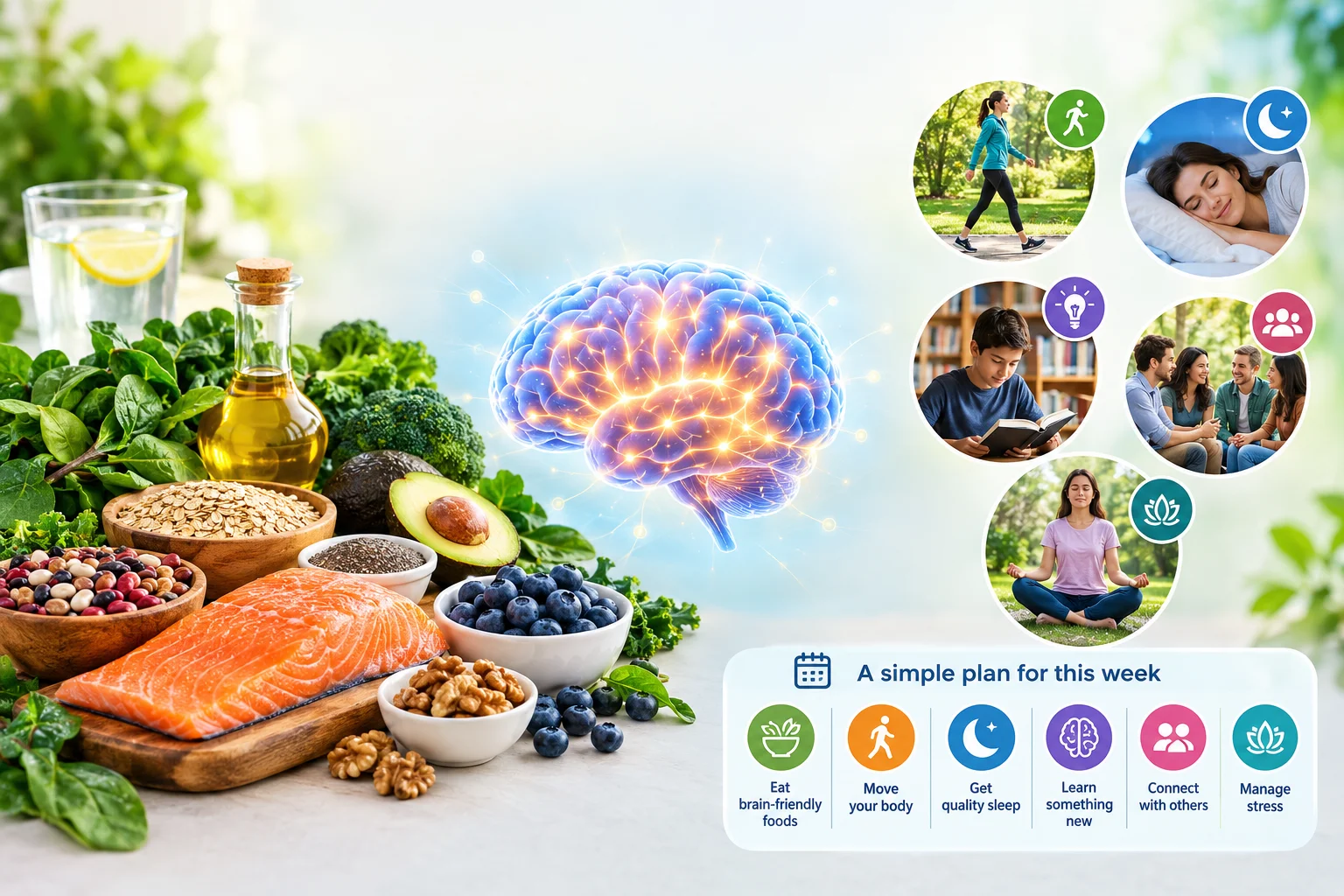
7. A simple week to get started
You don’t need to overhaul your diet. Add one small habit at a time and keep the ones you can live with.
| Day | One thing to add |
| Monday | A serving of leafy greens at lunch or dinner |
| Tuesday | Swap one sugary drink for water or unsweetened tea |
| Wednesday | Fish for dinner, if you eat it |
| Thursday | Beans or lentils in a meal |
| Friday | Fruit and nuts instead of a packaged snack |
| Saturday | A brisk 30-minute walk, ideally with company |
| Sunday | Plan a few simple meals for the week |
For a quick plate formula, aim for vegetables, a protein, a high-fiber carbohydrate and a healthy fat. For example: oats with fruit, nuts and yoghurt for breakfast; lentils, vegetables and whole-wheat roti for lunch fish with cooked vegetables for dinner.
Is forgetfulness normal, and when should you see a doctor?
Occasional forgetfulness is part of normal ageing. Forgetting why you entered a room, losing a word for a moment, or misplacing your keys doesn’t mean dementia or Alzheimer’s. What matters is the pattern and whether it affects daily life.
See a doctor if you or someone close to you:
- Repeats the same questions often
- Gets lost in familiar places
- Struggles to follow familiar instructions or manage money or medications
- Becomes confused about time or place
- Shows a marked change in personality or behavior
- Has memory problems that interfere with everyday activities
Memory problems have other causes too, including medication effects, poor sleep, depression, thyroid problems and vitamin deficiencies, some of which are treatable. A proper assessment beats guessing from a checklist online.
Frequently asked questions
Q1: What are the best foods for Healthy Brain?
There’s no single best food. The strongest case is for a varied diet of vegetables, fruit, whole grains, pulses, nuts, fish or other healthy proteins and unsaturated fats, in the style of Mediterranean, DASH and MIND diets.
Q2: What foods help memory?
Leafy greens, berries, fish, nuts and whole grains are often linked with better cognition. No individual food has been proven to prevent dementia or guarantee a better memory.
Q3: Are fish oil supplements good for memory?
Studies show a clear cognitive benefit in healthy older adults.
Q4: Are ultra-processed foods bad for the Healthy Brain?
Higher intake has been linked with greater dementia and cognitive-impairment risk in studies, including a large 2026 U.S. analysis. That doesn’t prove they cause it, but it supports building your diet around minimally processed foods.
Q5: How much sleep does the brain need?
There’s no number that guarantees protection. Around seven hours is a sensible target, since persistently sleeping six hours or less in midlife was linked with higher dementia risk in one long-term study.
Q6: Is it too late to start?
Healthy changes are still worth making later in life. In the U.S. POINTER trial, older adults at risk of decline improved their cognition over two years with a multi-part lifestyle programme.
The bottom line
The latest research shows habits that protect the rest of your body seem to help your brain too. Eat more vegetables, fruit, pulses and whole grains. Choose fish and nuts if you enjoy them. Keep ultra-processed foods from dominating your plate. Move often, sleep well, know your blood pressure and cholesterol, look after your hearing and vision, and stay mentally and socially engaged.
No headline food can do the work of a whole lifestyle, and nothing here promises a dementia- or Alzheimer’s -proof future. What it offers instead is a set of ordinary habits that are good for you regardless.

Saba Shafique is a Content Writer at ITZ Magazine, creating clear, informative, and reader-friendly content covering health, fitness, wellness, nutrition, and healthy living. She focuses on making complex topics easy to understand while providing practical information readers can use in everyday life.